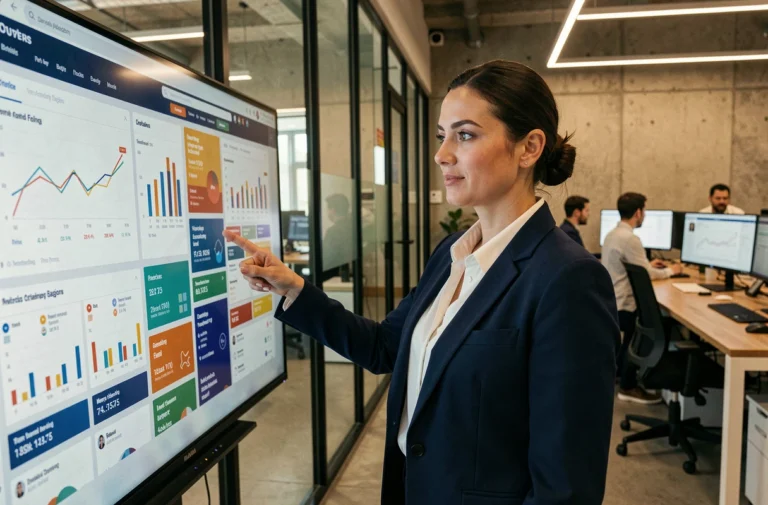
In 2023, nearly 60% of large European companies reported using at least one artificial intelligence solution in their internal processes, according to Eurostat. Financial departments are automating fraud detection, while human resources are speeding up recruitment through predictive analytics.
For many SMEs, AI means increased efficiency: some are seeing productivity gains without resulting in job cuts. Other companies, hindered by regulations or technical complexity, are still hesitant to take the plunge. This disparity is shaping new competitive balances in the market.
Why artificial intelligence is becoming a driving force for transformation in companies
The emergence of artificial intelligence is disrupting the codes of the professional world. From SMEs to mid-sized enterprises, all are looking to leverage predictive analytics, machine learning, and generative AI to accelerate their digital transformation. The speed of data processing is no longer just for automation: it provides a reliable foundation for decision-making, more robust and transparent.
Company management is rethinking the end-to-end value chain. Now, the goal is to provide access to reliable, data-driven information at every level of the hierarchy. AI tools in business are transforming process management, making production more efficient, and tracking hidden costs. In this context, AI is becoming an accelerator of innovation, paving the way for new products and services.
For those looking to explore these opportunities, https://business-intelligent.fr/ offers in-depth analyses and practical advice for integrating AI into governance strategy. It provides insights to guide decision-making, identify skills to develop, and envision tailored applications.
The data-driven company is no longer a distant horizon. It is becoming the norm, driven by the massive exploitation of information and the ability to adapt to market fluctuations. Consolidating flows, securing exchanges, designing customized tools: each step pushes organizations to rethink their models and invest in upskilling their teams.
Concrete applications of AI: how sectors are reinventing their practices
The impact of artificial intelligence is measurable on the ground, sector by sector. In industry, predictive maintenance is changing the game. Thanks to data analysis from sensors, unexpected downtimes are significantly reduced. Algorithms detect early signs of failure well before emergency intervention is required. Technical teams save time, which they dedicate to continuous improvement, quality, and the search for innovative solutions.
Quality control has reached a new level: today, AI tools scan every manufactured part in real-time. No longer is it necessary to rely on randomly chosen samples: the entire production is subjected to automated, constant analysis, without fatigue or human bias. For the supply chain, predictive analytics adjusts inventory, anticipates shortages, and reduces excesses.
In customer service, conversational AI handles the simplest requests. Advisors, freed from these repetitive tasks, can focus on complex cases. In human resources, practices are evolving: automated analysis of applications, detection of weak signals in internal mobility, and identification of training needs through performance analysis are now commonplace.
Generative artificial intelligence is also making its way into content creation: automatic generation of texts, images, and acceleration of communication campaigns. As for robotic process automation (RPA), it takes care of tedious and repetitive tasks, allowing professionals to focus on high-value missions.

What evolutions will AI bring to the professional world?
Digital transformation is intensifying as artificial intelligence becomes part of the daily lives of companies. SMEs and mid-sized enterprises are revising their organization, rethinking the profiles they seek, and investing in acquiring skills in machine learning and data analysis: know-how that is now strategic.
Human resources are relying on new tools to map training needs, anticipate changes in jobs, and attract hybrid talents capable of combining industry expertise with mastery of advanced technologies.
Decisions are based on quality data, allowing for trend anticipation through predictive analytics and adjusting strategy with greater agility. Management now has solutions capable of transforming an ocean of raw information into reliable guidance, breaking away from routine or mere intuition. Artificial intelligence empowers companies to build flexible strategies, ready to face uncertainties and economic complexity.
The distribution of tasks is evolving: repetitive missions are fading in favor of creativity and initiative-taking. Focusing on skill development and the integration of AI places humans at the heart of change. The promise? A more mobile, more analytical professional world, but above all, one that demands greater adaptability and continuous learning. AI is far from finished reshaping the landscape: the question is no longer whether it will prevail, but how each individual will adapt to it.