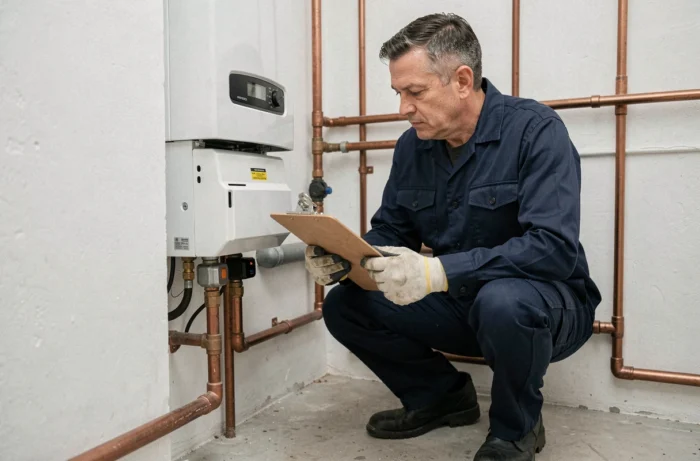
Buying a property equipped with an old boiler exposes you to costs that a standard visit may not always anticipate. The annual maintenance certificate, often the only document presented by the seller, provides information about past maintenance, but it says nothing about the actual condition of the components or the consistency between the heating system and the rest of the building. Checking a boiler before purchase requires going beyond this certificate.
Consistency between boiler, insulation, and energy performance certificate: the real starting point
Most guides focus on the maintenance certificate or the seller’s legal obligations. The first reflex should be different: check if the existing boiler still corresponds to the thermal reality of the property.
The energy performance certificate is based on a conventional consumption. Two properties with the same label can show very different heating bills depending on insulation, ventilation, occupancy habits, and system settings. Relying solely on the label to assess the relevance of the existing boiler is like reading a summary without opening the file.
For a house rated E, F, or G, the question takes on another dimension. Since January 1, 2025, the regulatory energy audit also applies to individual houses and multi-unit buildings rated E. This audit must present at least two renovation scenarios and be provided to the buyer during the first visit.
Before even inspecting the burner or the heat exchanger, it is essential to read this audit to know whether the boiler is scheduled to be replaced in a comprehensive renovation program.
The stakes for the buyer are simple: a boiler that works today but will need to be replaced by a heat pump or hybrid system within two years is not worth the same investment as equipment compatible with the building for the next decade.
Technical checks on gas or oil boilers: what the certificate does not cover
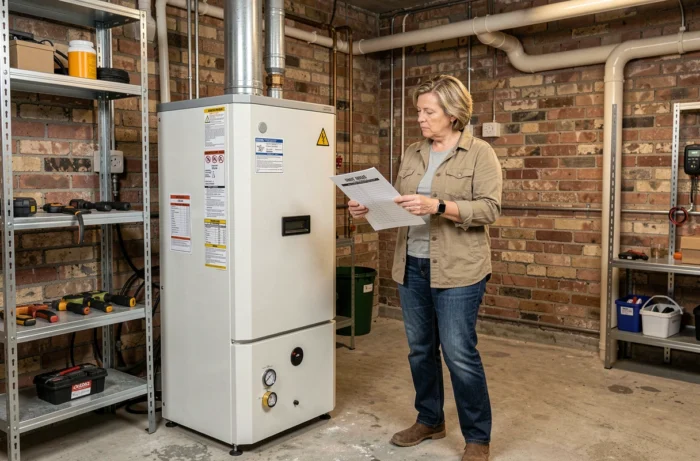
The mandatory annual maintenance includes cleaning the burner, checking safety devices, and measuring carbon monoxide levels. This is a routine operational assessment, not a wear diagnosis. Several elements deserve separate inspection when considering checking a boiler before purchase in the context of a real estate transaction.
- The heat exchanger: a scaled or perforated exchanger significantly reduces efficiency. Green corrosion marks on a copper exchanger, or white deposits on an aluminum model, indicate advanced wear that routine maintenance does not correct.
- The cast iron heat exchanger: on boilers over fifteen years old, microcracks can cause slow leaks. An experienced heating technician can spot these defects by pressurizing the circuit, a procedure not included in the standard annual inspection.
- The flue gas exhaust: an outdated flue or a connection not compliant with current standards may require extensive work. In a co-ownership, the issue of the collective flue (Alsace type or shunt) further complicates the diagnosis, as the condition of the flue depends on the entire building.
- Regulation and programming: a condensing boiler connected to a basic thermostat or oversized radiators loses a significant part of its theoretical advantage. Checking the compatibility between the regulation, emitters (radiators, underfloor heating), and the boiler provides a more accurate picture of actual comfort.
The maintenance certificate proves maintenance, not longevity. A piece of equipment maintained every year can still be at the end of its life if its internal components have never been replaced.
Age of the boiler and availability of spare parts
The age of a boiler is not just a number on a nameplate. What matters is the availability of spare parts. When a manufacturer stops producing a model, parts generally remain available for about ten years. After this period, finding an exchanger, a three-way valve, or an electronic board can take weeks, or may even prove impossible.
Before signing, a practical check involves noting the brand, model, and serial number of the boiler, then contacting the manufacturer’s after-sales service or an authorized heating technician to confirm that common wear parts are still available. This process takes a few minutes and can prevent an unanticipated complete replacement in the acquisition budget.
The case of oil boilers in properties rated F or G
Regulations now prohibit the installation of new oil boilers in new properties and during replacements. For a buyer, acquiring a property equipped with an old oil boiler in a poorly rated home means that replacement is almost certain in the short term. The cost of this transition must be included in the price negotiation, not discovered after signing.
Request an independent diagnosis before signing: cost and limitations
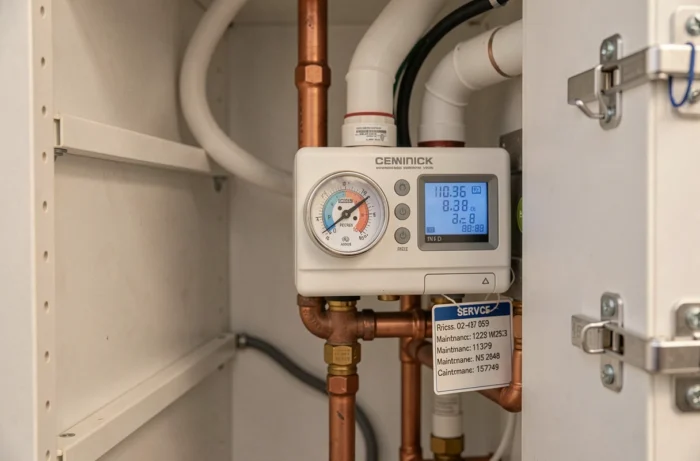
The annual maintenance is the responsibility of the occupant (tenant or owner). However, nothing obliges the seller to have a thorough diagnosis of the boiler conducted before the sale. The buyer can request that an independent heating technician carry out an additional technical visit.
This visit generally covers pressurizing the circuit, visually inspecting internal components, measuring combustion efficiency, and checking the tightness of connections. The cost remains modest compared to the amount of a boiler replacement.
Field feedback varies on the ease of access to the property for this type of visit before the compromise. Some sellers accept without difficulty, while others refuse. In this case, including a suspensive clause related to the condition of the heating system in the sale agreement remains an option to discuss with the notary.
A property whose boiler has been checked beyond the simple annual certificate offers budgetary visibility that mandatory diagnostics (energy performance certificate, gas, electricity) do not provide on their own. The mandatory gas diagnosis checks the safety of the installation, not the lifespan of the device. The distinction is significant for anyone planning to keep the existing system for several years after purchase.