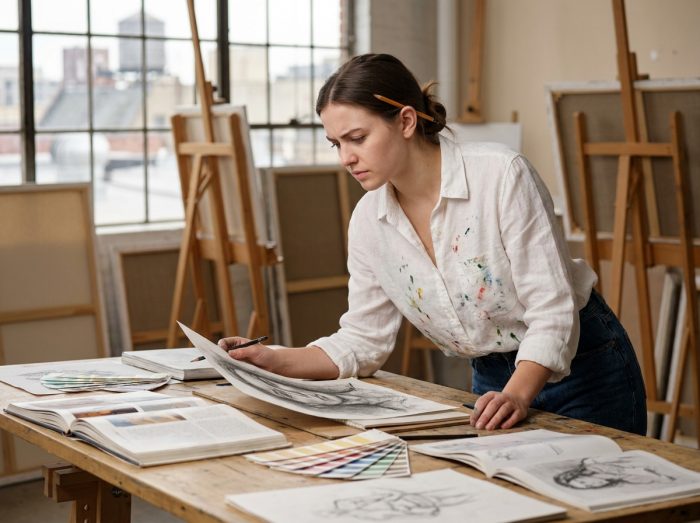
A general high school graduate entering art prep does not lack general culture; they lack plastic language. The prep does not correct a gap; it installs a technical vocabulary (volume, chromatic, spatial composition) that general high school does not convey. It is this acquisition that justifies the year, not a vague need to “mature their project.”
Generative AI in art prep: what changes concretely in the curricula
Art preps that ignore generative AI are already training for a profession that is out of sync. Since 2025, several institutions have integrated modules dedicated to Midjourney, Stable Diffusion, or assisted prototyping tools. The goal is not to replace observational drawing but to overlay manual skill and mastery of generative tools.
Concretely, this takes the form of workshops where the student generates variations from their own sketches and then manually reworks the result. The reverse process, starting from a generated image to extract a pencil composition, is also practiced. This back-and-forth between gesture and algorithm changes how a jury evaluates a portfolio.
For a general high school graduate, it is a less intimidating entry point than a blank page. Familiarity with digital interfaces partially compensates for the lack of prior plastic practice. We observe that profiles from NSI or mathematics specialties adopt these tools faster than average.
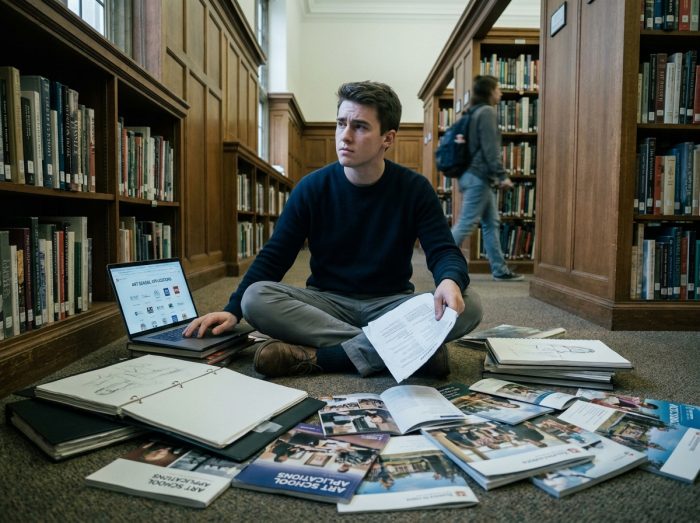
Asking whether an art prep after the high school diploma is suitable also involves evaluating the place that the institution gives to these new tools in its program. A prep that does not mention them in 2026 prepares for competitions from five years ago.
Dropout rates in art schools: the effect of prep on retention
Students who have gone through a year of art prep show a significantly lower dropout rate in their first year of art school compared to those who entered directly, less than 15% versus about 30% for direct entrants. This differential is not solely explained by the technical level acquired.
The prep calibrates expectations before the pedagogical shock of higher education. A general high school graduate discovers in prep the rhythm of collective critiques, the requirement to verbalize a process, and the autonomous management of a workshop. These non-technical skills are precisely those that cause students who entered without transition to drop out.
The argument of “lost time” collapses in the face of this data: a year of prep reduces the risk of losing two or three years in a poorly chosen or poorly prepared field.
Parcoursup 2026 and quota without portfolio: what it changes for general high school diplomas
The Parcoursup 2026 reform imposes a minimum quota of 20% of places in art preps accessible without a prior portfolio. This measure directly targets general high school graduates who have never created a portfolio.
Before this change, a high school student without a visual arts specialty had to cobble together a graphic portfolio in a few months, often with mediocre results compared to candidates from STD2A or applied arts final year. The quota removes this barrier to entry without lowering the exit level.
We recommend that concerned candidates check three points before applying:
- Does the prep explicitly display its Parcoursup quota without portfolio, or does it only meet the regulatory minimum?
- Is the catch-up program in drawing and volume structured over the first six months, with individualized follow-up?
- Do the results of previous cohorts’ competitions distinguish profiles with and without an initial portfolio?
An institution that is transparent about these three criteria deserves to have a year invested in it.
Art prep in alternating format: the hybrid model rising for digital design
Hybrid art preps in alternating formats are beginning to surpass traditional formats on one specific point: the professional network established from the first year. For a general high school graduate aiming for digital design, UX, or motion design, this format presents a structural advantage.
Alternating in art prep is not an observation internship. The student integrates into a studio or agency two days a week, works on real projects, and returns to the workshop with concrete client constraints. This mechanism forces a technical maturation that the traditional prep only achieves at the end of the year.
The format remains rare and concentrated in a few institutions. According to the CNAM study “Alternance en arts appliqués 2025-2026,” these hybrid paths produce candidates better equipped for schools oriented towards digital design.
- The alternating format partially finances tuition, a non-negligible argument when private preps charge several thousand euros per year
- The end-of-year portfolio includes professional projects, not just academic exercises
- The transition to the company reveals very early whether the targeted sector truly matches the candidate’s expectations
A general high school graduate without a network in the artistic field has more to gain from this format than from a traditional full-time prep, provided they accept a demanding pace.
The question is not whether art prep is worth a year. It is about knowing which one. A general high school graduate who chooses a prep integrating generative AI, applying the Parcoursup quota without portfolio, and offering a format suited to their profile does not waste time. They gain a head start over technically more advanced candidates but less strategic in their orientation.