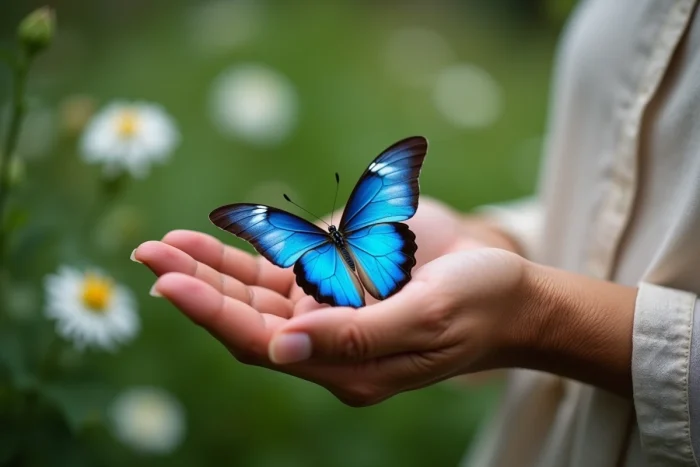
One rarely stumbles upon a blue butterfly by chance. Whether it’s a Morpho crossing a tropical clearing or an Azure perched on a limestone bank in Europe, the encounter leaves a mark. This rarity in nature explains why so many cultures have imbued this insect with a symbolic weight far greater than that of other butterflies. The blue butterfly crystallizes very different interpretations depending on the tradition, continent, and era.
Morpho, Azure, Adonis: symbolism changes with the species
Online competitors refer to the “blue butterfly” as a single block. In reality, the situation is more nuanced. A Morpho menelaus from the Amazon, whose wings reach a wide span and produce an iridescent blue through light diffraction (not pigment), does not have the same cultural grounding as a Polyommatus icarus from European meadows.
In Central and South America, it is the Morpho that fuels the narratives. Its size and metallic sheen make it an immediately recognizable creature in the canopy. Among several indigenous peoples of the Amazon, the blue Morpho is associated with the passage between the visible and the invisible world, a messenger between the living and the ancestors.
In Europe, blue butterflies are smaller and more discreet. The Common Azure or the Adonis frequents dry grasslands. Their symbolism is less spectacular but equally rooted: they appear in medieval imagery, often linked to the fragility of the soul. This distinction according to local species remains a blind spot in most available resources. To delve deeper into the meaning of the blue butterfly according to Masculin, one can find a panorama that intersects several of these traditions.
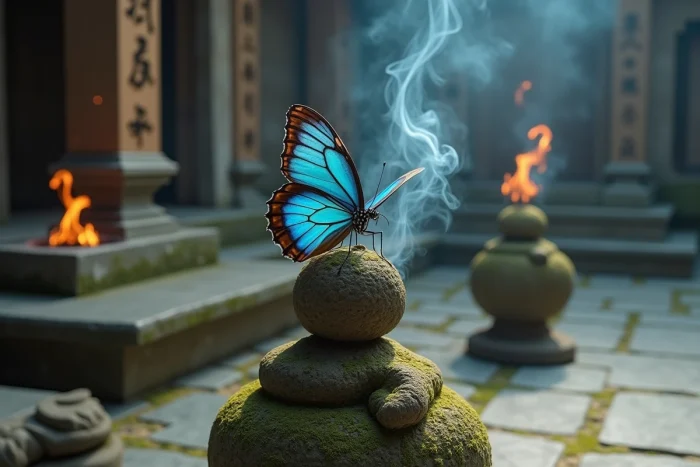
Blue butterfly in Greek mythology and Aztec tradition
In ancient Greek, the word “psyche” refers to both the soul and the butterfly. According to mythology, Prometheus shaped the human body from clay, and Athena breathed a butterfly into it to animate it. The butterfly thus embodies the very breath of life itself, not merely a decorative symbol.
The blue color adds another layer. In ancient Greece, deep blue refers to the divine, to what transcends the human sphere. A blue butterfly does not represent just any soul, but a soul directly connected to the sacred.
Among the Aztecs, a link with fallen warriors
Among the Aztecs, the butterfly symbolizes the soul or life force, as in Greek tradition, but with a warrior dimension. Butterflies accompanied the souls of fallen fighters to the sun. The blue and turquoise variants were associated with Tlaloc, the deity of rain and fertility.
Here we find a common point between two civilizations that never crossed paths: the blue butterfly serves as a symbolic vehicle between death and regeneration. The metamorphosis of the caterpillar into a butterfly, passing through the cocoon and chrysalis stages, makes this interpretation almost obvious.
Symbolism of the blue butterfly in Asia: Japan, China, Vietnam
In Japan, the butterfly is the emblem of womanhood and feminine transformation. The blue does not carry the same connotation as in the West: it is linked to serenity and purification. In the Shinto context, encountering a blue butterfly can be interpreted as a sign of transition to a new stage of life.
In China and Vietnam, the butterfly serves to express a wish for longevity. The association with blue reinforces this dimension: blue evokes the sky, duration, stability. The interpretations vary on this point according to regions and historical periods, but the common thread remains positive metamorphosis.
- In Japan, the blue butterfly is associated with feminine transformation and spiritual purity.
- In China, it carries a wish for longevity, reinforced by blue which refers to the sky and duration.
- In Vietnam, the butterfly as a whole symbolizes joy and renewal, with blue adding a dimension of inner calm.
- In Buddhist traditions, the butterfly reminds us of impermanence: its brief life illustrates the transient nature of all existence.

Blue butterfly and contemporary spirituality: totem animal and dreams
In current spiritual practices, the blue butterfly is often cited as a totem animal. It is attributed a guiding role during periods of personal change. Encountering a blue butterfly would be a signal of ongoing inner evolution, an invitation not to resist transformation.
In terms of dreams, seeing a blue butterfly is generally interpreted as a positive message. The insect then represents the light at the end of a difficult period, a movement of the spirit towards greater lightness and joy.
What it looks like in practice
For those who use these symbols in their daily lives (tattoos, jewelry, meditation), the blue butterfly serves as a visual reminder of an intention for transformation. The choice of blue rather than another color reflects a search for calm and depth, not passion or raw energy.
- In tattoos, the blue butterfly is chosen to mark a period of personal rebirth or a grief experienced.
- In lithotherapy, it is sometimes associated with blue stones (lapis lazuli, aquamarine) to amplify the intention of serenity.
- In decoration or art, it evokes inner journeys and connection to the spiritual world.
The blue butterfly traverses traditions without ever carrying exactly the same message, but a thread connects all these interpretations: metamorphosis, the passage from one state to another, the chrysalis as a necessary stage. What varies is the context, the local species, the exact shade of blue. The symbol works because it is rooted in an observable biological reality: the caterpillar disappears, the butterfly appears. The rest, each culture has written in its own way.