Defrosting mirrors is one of those functions that many drivers ignore or underutilize in winter. On recent vehicles, the system is no longer just a simple button: it can activate on its own, turn off unexpectedly, and condition the proper functioning of driving aids. Understanding its logic changes the way to approach frosty mornings.
Automatic or manual mirror defrosting: what distinguishes vehicle generations
| Feature | Manual systems (before 2020) | Automatic systems (after 2022) |
|---|---|---|
| Activation | Dedicated button on the console or coupled with the rear window | Controlled by external temperature sensors, humidity, sometimes ADAS camera |
| Dashboard indicator | Light visible as long as the function is active | Often no dedicated icon, activation in the background |
| Operating duration | Active until the driver turns it off | Automatic duration limitation to save energy |
| ADAS coupling | None | Frost on the mirror can disable the blind spot alert or emergency braking |
This evolution explains a common misunderstanding: drivers of VW ID., Audi Q4 e-tron, or Tesla Model 3 Highland think their mirror defrosting does not work, while it activates and turns off automatically without a visible notification. The system reacts to external conditions, not to a manual command.
Knowing how to use the mirror defrosting on your specific model avoids searching for a button that may no longer physically exist.
Automatic duration limitation: why mirror defrosting turns off in the cold
In Hyundai and Kia, the mirror defrosting function is coupled with the rear window. It automatically turns off after a few minutes, even if the indicator light remains on. In very cold climates, this discrepancy between the light and the actual heating stop surprises users.
This automatic duration limitation protects the heating elements from premature aging and reduces electrical consumption. On a thermal vehicle, the impact remains marginal. On an electric vehicle, every watt counts to preserve winter autonomy.
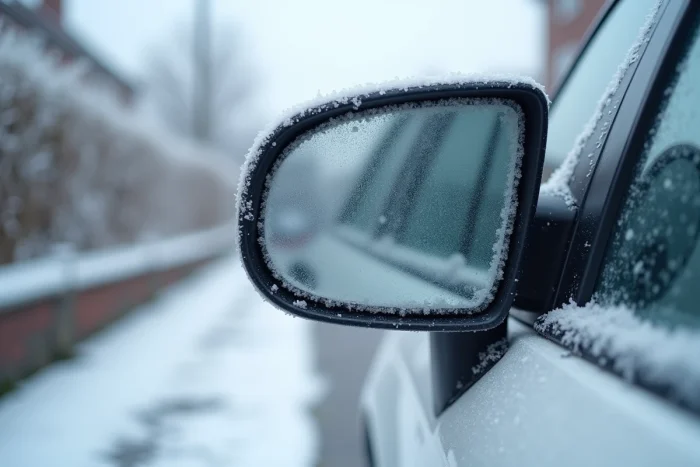
The concrete problem: if the outside temperature remains very low, frost can reform after the automatic cutoff. The driver, seeing the light on, believes the mirror is clear while a thin layer of ice already covers the surface.
- Visually check the state of the mirror after a few minutes, even if the light is on
- Manually restart the function if the vehicle allows it (on some models, a long press reactivates the cycle)
- Do not scrape the heating surface with a hard object, at the risk of damaging the resistance integrated into the mirror
ADAS sensors and frost on mirrors: an underestimated safety risk
The 2023-2024 manuals from Volvo, Hyundai, and Kia explicitly mention that frost-obstructed sensors can disable the blind spot alert or emergency braking. Side cameras, blind spot radars, and parking sensors depend on a clean mirror surface to function properly.
Mirror defrosting is therefore no longer just a matter of visual comfort. It conditions the calibration of driving aids. A frosted mirror potentially means an ADAS system that operates in degraded mode without clear warning.
This dependence raises a practical question: activating the mirror defrosting before starting should be part of the winter routine just like defrosting the windshield. On vehicles equipped with remote preheating (via mobile app), the function sometimes activates automatically with the air conditioning.
Maintenance of the mirror defrosting system in winter
The manuals of several Asian compact SUVs and European electric vehicles emphasize a often overlooked point: never pour hot water on a heated mirror. The thermal shock between the internal resistance and boiling water can crack the mirror or detach the heating element.
Chemical de-icing spray remains compatible with heated mirrors, provided it is not applied excessively. The accumulation of chemical residues on the mirror surface reduces reflectivity and can interfere with the integrated light sensors on some high-end models.
- Prefer the integrated defrosting system over chemical or mechanical solutions
- Regularly clean the mirrors in winter with a microfiber cloth to avoid the accumulation of salt and residues
- Consult the vehicle manual to identify if the defrosting is coupled with the rear window or has an independent control
Mirror defrosting is part of a set of winter functions (suitable tires, windshield visibility, lighting) that only work well when combined. On recent vehicles, the automatic logic of the system requires knowing its actual behavior rather than relying on the dashboard light. Frost on a mirror is no longer just a comfort inconvenience; it is an input for the vehicle’s active safety systems.