The law does not concern itself with superfluous details: accessibility in establishments open to the public follows an unyielding mechanism of standards, dimensions, and smooth circulation. For warehouse managers, each new rule often feels like a new mountain to climb, with additional costs, technical constraints, and a regulatory puzzle that seems endless. However, a fine and precise blade, coupled with industrial ingenuity, can today reverse the trend. Between advanced automation and scrupulous adherence to legal requirements, new solutions are transforming a complex obligation into an operational asset.
Warehouse Automation: What Challenges for High Access?
Automation is redefining industrial logistics and imposing new standards for high access. In spaces where every meter counts, making the most of verticality becomes a priority, without ever compromising on safety or compliance with regulatory guidelines. The staircase, in an ERP, transforms: it is no longer just a passage, but a centerpiece of the logistics chain. Its design, placement, and ability to absorb traffic condition the overall efficiency of the site.
The law sets the framework through the decree of August 1, 2006, and the law of January 11, 2005: every ERP must guarantee suitable access for every person, whether it is an employee, a customer, a parent with a stroller, or a hurried delivery person. As soon as the height to be crossed exceeds 1.20 meters, a PMR lift must be provided; below this threshold, a PMR lifting platform may suffice. Some modular configurations, like the FlexStep, combine traditional stairs and platforms, thus offering unprecedented flexibility to meet all visitor profiles.
The laser cutting and ERP stair solutions pave the way for tailored responses, aligned with every building or internal logistics constraint. These processes allow for strict adherence to minimum dimensions, visual contrasts, and the non-slip quality of surfaces. By integrating this equipment, industrial sites streamline movements, enhance team safety, and gain speed in interventions, all while never deviating from the regulatory standards imposed by automation.
Laser Cutting and ERP Stairs: Innovations for Logistic Performance
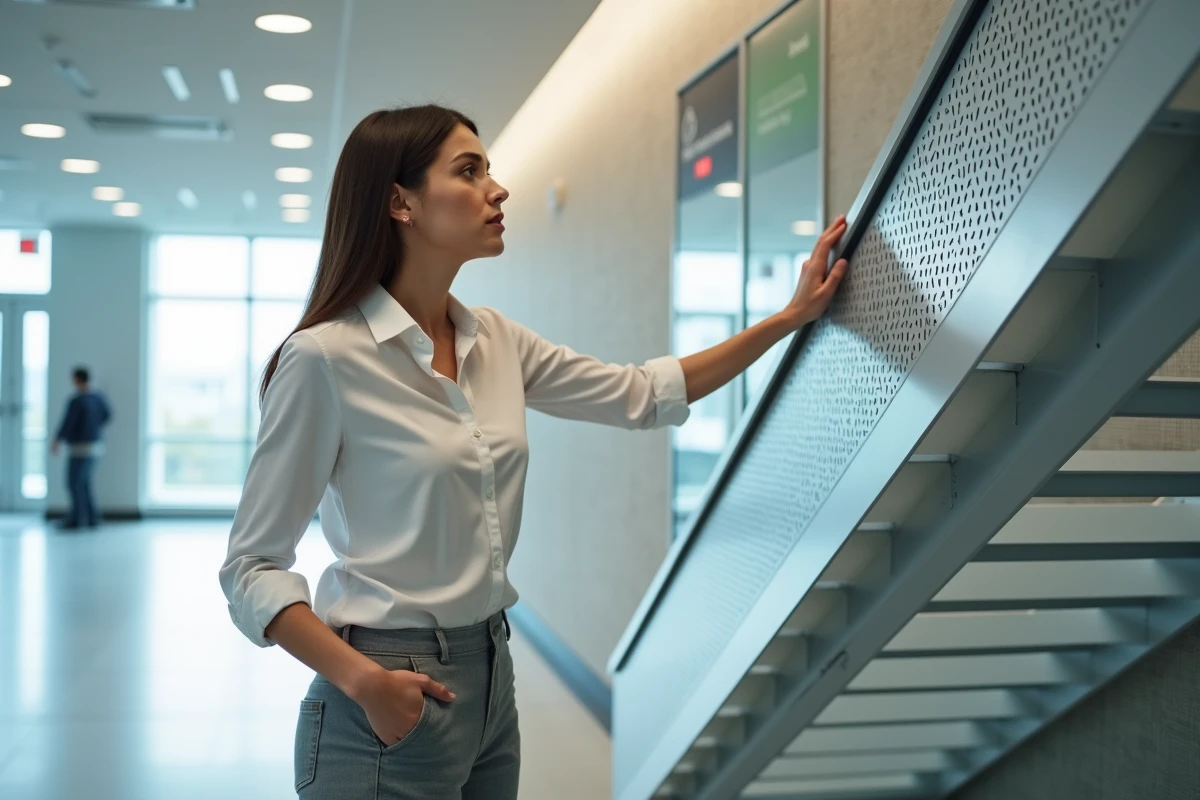
Laser cutting is revolutionizing the way stairs for ERPs are designed and manufactured. Thanks to digital precision, each component, step, riser, and handrail benefits from an unmatched level of finish that is impossible to achieve with manual methods. This technology ensures strict compliance with the NFP 01.012 standard: perfectly calibrated step height, regular tread, non-slip and contrasted nosing, and a vigilance alert strip precisely positioned.
Modularity is emerging as the new standard. In the workshop, stainless or galvanized steel is shaped by laser, ensuring robustness and longevity. The pieces are then assembled according to the building’s specifics, facilitating installation and subsequent interventions. In the process, this method saves time on manufacturing and achieves an excellent balance between cost and quality for the operator.
Here are the main elements that characterize this modern approach:
- Handrail: continuous, sturdy, installed on both sides, between 0.80 m and 1 m high, and extended beyond the steps to better assist the user.
- Guardrail: compliant with the NFP 01.012 standard, with a minimum height of 0.90 m and enhanced visual contrast for increased safety.
- Vigilance alert strip: positioned 0.50 m from the top of each staircase, with a clear texture and visual contrast to alert any user.
Production lines benefit from the complementarity between laser cutting, precision welding, and mechanical welding. The result: industrial equipment adapted to the nature of traffic, capable of absorbing intense comings and goings and accommodating all visitor profiles, including people with reduced mobility. The consistency offered by digital control guarantees constant quality, even in the smallest details of the steps or guardrails.
What Concrete Benefits for Safety and Efficiency of Installations?
User safety in an ERP goes beyond mere compliance with legal texts. Recent technical advances raise the level of expectation. Laser cutting offers a perfect fit for each component during installation, eliminating inaccuracies and risks of play. This attention to detail significantly reduces the risks of missteps, falls, and premature wear of equipment.
Stairs designed for ERPs are made for all audiences: people with reduced mobility, seniors, parents with strollers, and loaded delivery personnel. Hybrid systems, like the FlexStep, illustrate this adaptability: in a matter of seconds, a traditional staircase becomes a wheelchair-accessible lifting platform, without interrupting the flow. For any elevation between 1.20 m and 3.20 m, the installation of a PMR lift is mandatory, in accordance with regulations.
Among the benefits provided by these technologies, we can mention:
- Visual and tactile contrast: marked nosings, visible risers, vigilance alert strips allowing movement even in low light conditions.
- Structural robustness: the use of laser-treated steel ensures excellent resistance to impacts, corrosion, and reduces the need for maintenance interventions.
Customization and industrial streamlining allow each site to be equipped according to its specific constraints, in Paris as elsewhere. This technical requirement reflects on the entire logistics chain: performance, safety, and accessibility become inseparable. Now, we just need to imagine what logistics would look like if every staircase, every access, every vertical flow were designed as a precision piece, adapted for everyone, without compromise.