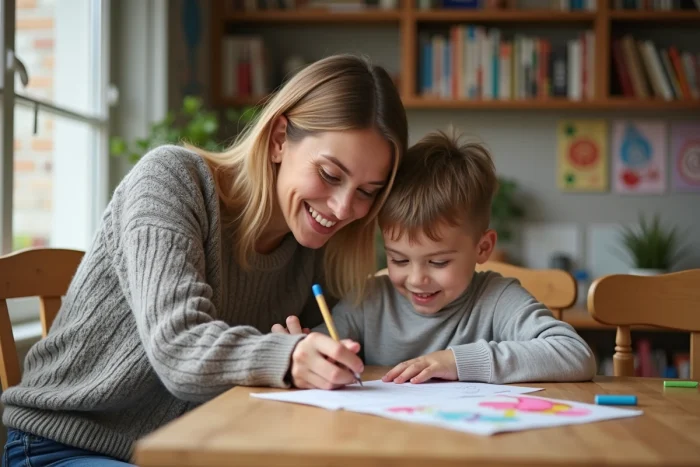
A child does not learn to manage their emotions simply by receiving instructions. No universal method ensures the same progression for everyone. Unpredictable reactions, temporary failures, and frequent doubts are integral parts of the educational process.
The reference points change according to the age, environment, and personality of each child. What works for one may prove unsuitable for another, even within the same sibling group. Adapting, observing, adjusting: the uniqueness of each journey requires a regular reassessment of practices.
Positive education: what principles to better understand your child?
At the root of positive education is the belief that a child does not thrive under threat or punishment. They develop through contact with adults who rely on respect, empathy, and the willingness to find solutions together. This approach is largely inspired by the thoughts of Winnicott, Dolto, and the duo Faber and Mazlish. Here, communication flows, and autonomy is cultivated while maintaining structuring limits. It is not about giving in to ease, but about providing a solid framework where rules make sense, where the child learns to cooperate and to find meaning in what is offered to them.
Discoveries in neuroscience confirm this: the way a parent interacts influences the maturation of their child’s brain. Encouragement, sincere listening, and attention to emotions all build trust and well-being, the foundations of harmonious development. An adult who applies these principles gives the child the space to express themselves, to experiment, to make mistakes, and to try again, without fear of disappointing.
Gentle parenting is not about giving in to everything. It is about learning mutual respect: setting age-appropriate limits, explaining the reasons behind each rule, recognizing effort rather than just results. Being a coherent parental model means providing a solid and reassuring reference point that comforts the child and fosters a relationship based on trust. To explore these concepts in more detail, the resources from Maman du Net offer in-depth analyses and practical tools designed for the daily challenges of families. Putting listening and understanding at the center of daily life is to engage in demanding parenting that does not compromise on kindness.
Concrete advice for establishing a climate of trust in daily life
Building a climate of trust is a matter of repeated gestures, small attentions, and consistency. The parent, as a stable model, inspires the child. They show, by example, what empathy and respect mean. Affective presence is expressed through concrete signs: an attentive ear, supportive words, an encouraging look. This secure environment helps the child assert themselves, gain autonomy, and nurture their curiosity.
Here are some effective levers to establish this trust over the days:
- Organize rituals of speaking and listening: set aside a dedicated time, away from digital distractions, to discuss the day, mention successes, small worries, and shared joys.
- Set clear limits, always explained. When the child understands the meaning of the rules, they integrate them with greater serenity.
- Support initiative: give them the opportunity to choose an activity, assert their preferences, and seek solutions when faced with an obstacle.
Play, too often relegated to the background, remains a powerful driver of development and imagination. Vary activities, propose new experiences, encourage discovery. Even during homework, keep in mind that the framework is important, but the child should be able to think, explore, and above all, that their efforts should be valued before the final result.
Trust is built through daily consistency: affection, but also reference points. A parent who supports, encourages expression, and respects the child’s pace lays the foundations for a solid relationship based on listening and mutual respect.

How to strengthen communication and parent-child complicity through positive education?
True dialogue, far from orders or automatism, becomes the key to a strong relationship between parent and child. With kind communication, everyone learns to put words to what they feel. This dynamic, supported by mutual listening, allows everyone to feel heard, respected in their emotions. Gradually, trust is established, the child feels free to express their doubts as well as their desires, their anger as well as their joys. From the parent’s side, acceptance takes precedence over judgment, proposals over injunctions.
Strengthening complicity also means recognizing every effort, every step forward. This support nurtures the child’s self-confidence, helps them navigate difficulties, and bounce back without fear of making mistakes. Look for solutions together, explore feelings rather than seeking the strictest punishment. Kindness is not laxity: it requires clear limits, set with respect, always explained.
To develop this dynamic daily, here are some concrete suggestions:
- Encourage informal exchange times, away from tensions and constraints.
- Ask open-ended questions to invite the child to share, argue, and project themselves.
- Highlight their successes and progress, even the modest ones.
Over the days, words, attention, and mutual respect weave a relationship of trust. The child then grows in a calm environment, supported at every stage of their learning. Nothing is fixed, everything is built, and every parent can, in their own way, pave the way for lasting complicity.